Classical Conditioning
Ever check your phone notifications even before you knew who messaged you? Hear a "ding" and your hand instinctively reaches for the screen? That's not magic. That's Classical Conditioning. It's the foundation of all the triggers we get used to.
Ivan Pavlov's famous experiments with dogs showed how new responses are formed.
When a dog sees food, the sight of the food causes it to salivate.

Food is unconditioned stimulus
+

The dog
=

Salivation to food is unconditioned reflex
Let's add regularly a sound of a bell when the dog sees food.
+

Initially, a bell wouldn't cause any reaction. But if regularly paired with food, the dog would start reacting to the bell as if it were the signal for food, but without the food. This is how a new behavior – a conditioned response – is formed.
The bell is neutral stimulus
+
The dog
=
Salivation to bell is conditioned reflex
Conditioned Reflex
Over time, the user will begin to react to the signal even without the initial stimulus.
Association
Repeatedly combine a neutral signal (sound, light, vibration) with a reward, and it will become a signal for action itself.
Examples
Sounds
When an incoming message arrives, a characteristic "ding-ding" sounds and a notification pops up rightarrow you automatically check the chat. Do you feel the sensation that the familiar notification sound evokes?
Skeleton Loading
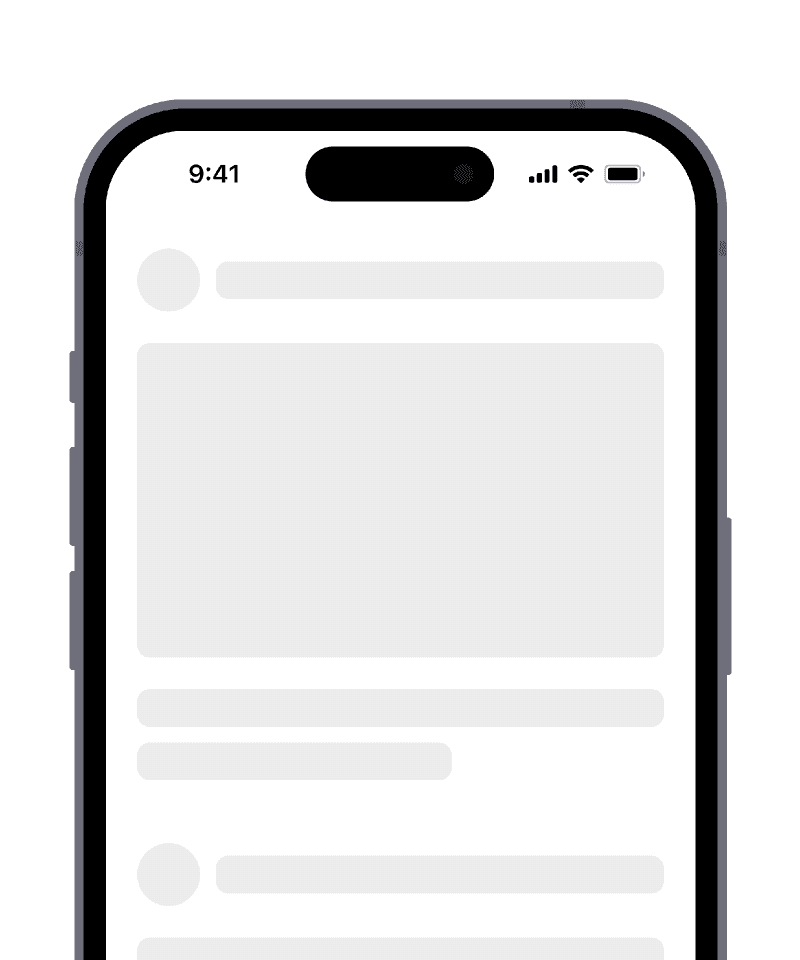
Users have learned to associate gray placeholder blocks with the immediate arrival of content. Unlike a generic spinner, this visual cue triggers a subconscious sense of progress, reducing the perceived wait time and keeping the user engaged during data loading.

Notification Badges
Initially, a red circle is just a shape. However, by consistently pairing it with social updates or news, the color itself becomes a trigger. Now, merely seeing the badge creates an instant physiological response, like anticipation or mild anxiety before the user even opens the app.
How to Apply It
Transform user attention into a habit in 3 steps.
Step 1: Identify the Value (The UCS)
First, define the natural reward your user craves. It could be social validation (a like), relief (task completed), or curiosity (new content).
Step 2: Assign a Unique Trigger (The Neutral Stimulus)
Create a distinct UI element that will announce the reward. It must be consistent and specific to this action. Toolkit:
Visual
A specific color, notification badge, or distinctive animation.
Sound
A unique "ding," "tick," or soft "swish" for a successful action.
Haptic
A specific vibration pattern, like a subtle tap or a sharp alert
Step 3: Enforce Consistency
The trigger must always predict the reward. If the "ding" sound happens without a new message, the association breaks. Repetition creates the reflex.
How to properly set up a Neutral Stimulus
To make your neutral stimuli effective, consider these qualities:

Subtlety
Avoid harsh changes in volume or jarring flashes.

Consistency
Make it consistent in style with your app's other micro-interactions.

Predictability
Use it no more than 3–5 times per session to avoid "oversaturation."

Next time you hear a "ding" and reach for your phone, remember Pavlov. He'd be proud of you.
If classical conditioning works through associations, the next model operates through consequences. It will show how rewards and penalties directly shape user behavior.